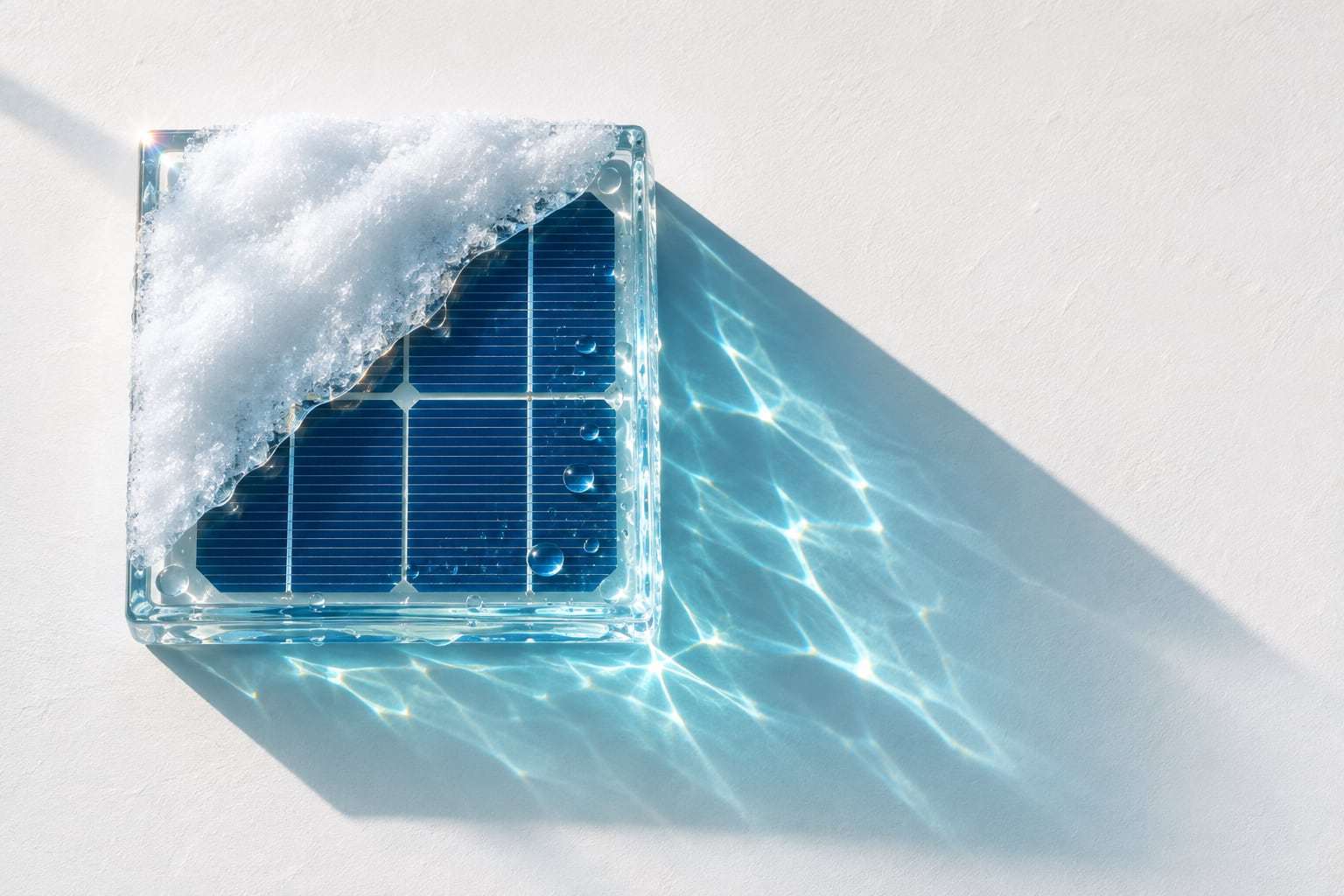
Usually not. On most Front Range roofs, the sun clears the panels within a few days of a storm, and a roof rake risks more than the lost output is worth.
Will the snow come off on its own?
On a pitched roof, almost always. Front Range storms are often followed by bright, clear days, and that is what makes the difference.
Here is what happens. Sunlight passes through a thin layer of snow and warms the dark panel underneath. A film of meltwater forms against the glass. Glass is smooth and the panel is tilted, so once that film forms, the whole slab lets go and slides off, often in one piece.
On a sunny day after a light storm, that can happen by noon. After a heavy upslope storm, it may take two or three days, with the top rows clearing first and the bottom row last.
Why not just rake it off?
Because the rake is the riskiest thing on the roof. Long-handled roof rakes are made for shingles, not for glass.
- Scratches: a rake drags grit, ice and its own edge across the glass and coating.
- Frame and clip damage: pulling hard on a frozen slab puts strain where panels are clamped.
- Warranty trouble: many manuals limit what can touch the glass. A metal or hard plastic rake is rarely on the list.
- Falls: working a rake from a ladder over an icy eave is how people get hurt.
- Falling snow: a slab released from above can land on you, a walkway or a gutter.
Our crew does not remove snow from rooftop arrays for the same reasons. We do not rake, chip ice or walk on panels, in any season.
Is the lost output worth worrying about?
Not much, honestly. Winter days on the Front Range are short, and the sun stays low in the southern sky. Even on a clear December day, your array makes a fraction of what it makes in June.
So a snow-covered day in winter costs a small part of a small number. A few days of cover after a storm barely moves your annual total. Compare that with the cost of a scratched panel, a pulled clip, or a fall.
Our article on why winter output drops explains what normal winter output looks like, so a snowy week does not alarm you when you open the app.
What about ground mounts?
Different story, because you can reach the glass from the ground without a ladder. If you want to help a ground mount along, you can, gently.
- Use a soft tool: a foam snow broom or a soft-bristle brush made for car glass.
- Push, do not scrape: move the loose snow down and off the low edge.
- Leave the last layer: the sun will clear the thin film faster than you can.
- Never chip ice: leave frozen patches to melt.
- No hot water: pouring warm water on cold glass risks thermal shock.
The ground mount page covers what makes those arrays different through the year, from snow to summer dust.
Can you melt it with a hose?
Please do not. Water sprayed onto cold panels in winter runs down and refreezes at the bottom frame and the eave, which is exactly where snow already lingers. You end up with ice where you had snow.
Warm water from inside the house is worse. Glass that has been sitting below freezing does not take kindly to a sudden change in temperature, and REC’s cleaning guide asks for water at ambient temperature for a reason. The same rule is why we only wash on dry days above freezing.
Where does snow linger?
In predictable places, and your app will show them.
- The bottom row: snow slides down and piles against the eave or gutter, shading the lowest cells.
- Low-tilt panels: shallow carports and flat roofs shed snow much more slowly.
- North-facing or shaded panels: less sun means less melt.
- Behind obstructions: below a dormer, chimney or a taller roof section.
That lingering strip at the bottom edge is normal. It often hangs on for a day or two after the rest of the array is clear, and then drops off in one go. Our page on snow and ice shows what those patterns look like from the ground.
What about snow sliding off the roof?
This is the part worth planning for. Panels shed snow faster and more completely than shingles do. A whole slab can let go at once and drop off the eave.
If your array sits above a door, a walkway, a deck or a driveway, keep people and cars out from under it on bright days after a storm. Fragile gutters and plants below the eave can take a hit too.
Snow guards or other ways to slow that slide are a question for your roofer or installer, not for a cleaning crew. We note it in our inspection if we see an array above a doorway, and we leave the recommendation to the right trade.
Does snow clean the panels?
A little. A sliding slab drags some loose dust off with it, and melting snow rinses the glass for hours. Many owners notice their panels look brighter in March.
But snowmelt has the same weakness as rain. It carries dirt down to the bottom frame and leaves it there, so the dirt line along the lower edge can grow over a winter. Droppings and sap do not move at all.
That is part of why a spring look makes sense once the snow is done. Our article on the best time to clean solar panels covers the timing in more detail.
When should you worry?
A few signs are worth a call to your installer or a closer look:
- Snow that will not slide for weeks: on a sunny, pitched roof, that is unusual.
- Ice dams at the bottom edge: water backing up under the array is a roofing question.
- Sagging on a carport or canopy: a heavy load on a structure is an installer question.
- A fault code or zero output on a clear day after the snow has gone: an installer question.
- Cracked glass once the snow clears: document it and call your installer.
Late-season storms can also come with hail in spring. If a storm drops ice pellets rather than snow, see what to check on your panels after hail.
What do we do in winter?
Quite a bit, just not snow removal.
- Washes on dry days above freezing: short visits, timed so water never freezes on the glass.
- Visual inspections: a look at every module once the array is clear.
- Monitoring: reading your data so a snowy week reads as snow, not a fault.
Winter washes are not the most common, but they have a place. With the sun low in the sky, light strikes the glass at a shallow angle, and any film left from autumn matters more. If your panels went into winter dirty, a dry, mild day in January or February can be a good time. The panel cleaning page covers how we decide.
Our performance monitoring is useful here too. It tells you whether a low week was snow, short days, or something that deserves a look.
What is the short version?
- Pitched roof: leave it. The sun will clear it within days.
- Ground mount: a soft broom from the low edge is fine. No scraping, no hot water.
- Under the eave: keep clear of sliding snow on bright days.
- After the snow: check your app on the next clear day.
Where to go from here
If you want to see what a normal winter looks like for your array, start with your numbers in the output check and the month-by-month view in the Front Range solar year. If your panels went into winter with a film on them, you can book a dry-day wash whenever the weather allows.