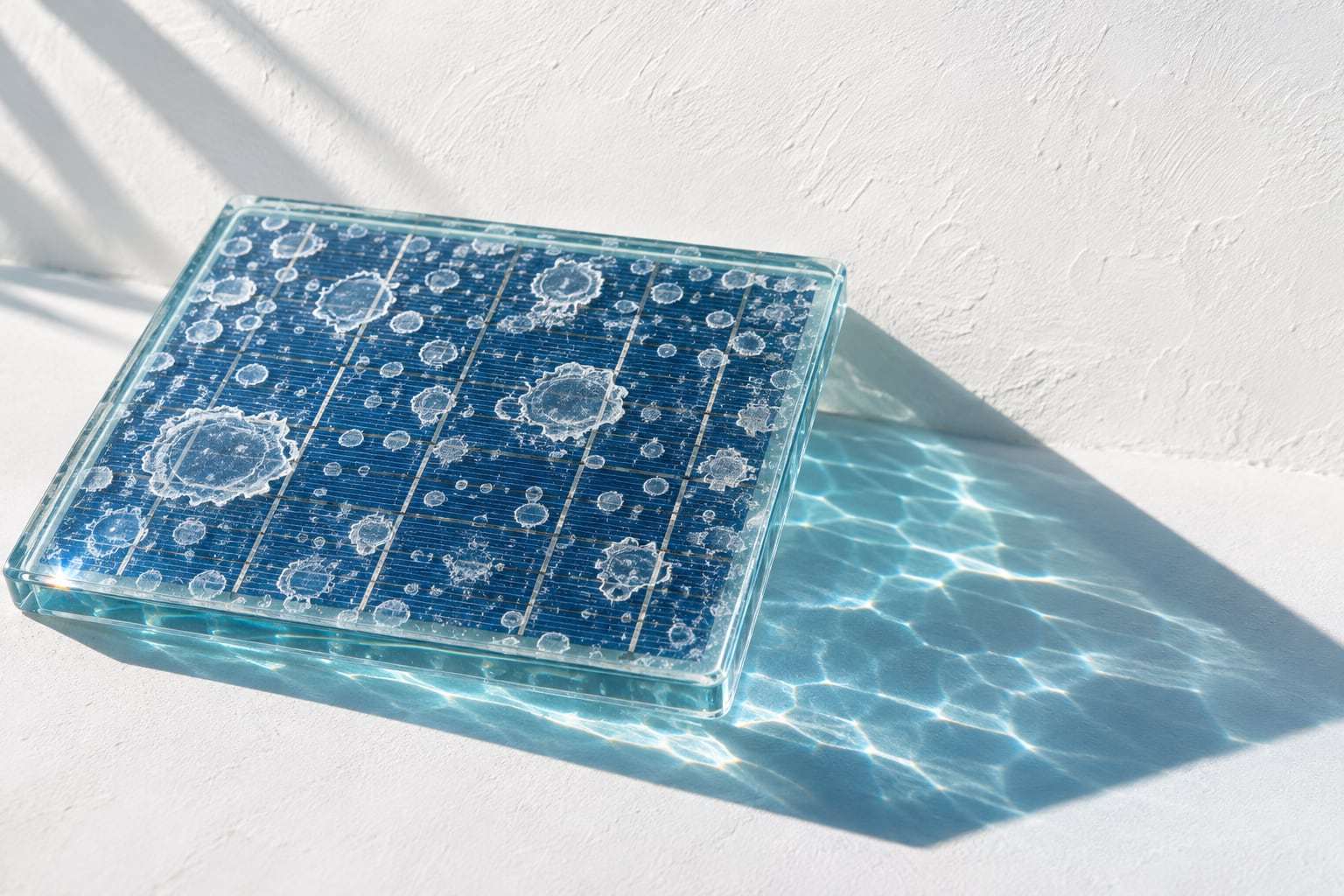
Where do water spots come from?
From tap water drying on the glass. Hose and sprinkler water carries dissolved minerals, and when a drop evaporates they stay behind as a white ring. Pure water carries almost nothing, so it dries clear.
When does it land?
After a hose or sprinkler
- Jan
- Feb
- Mar
- Apr
- May
- Jun
- Jul
- Aug
- Sep
- Oct
- Nov
- Dec
How do I recognize them?
White rings
Round chalky marks where single drops dried, clearest in low sun.
Sprinkler arcs
A fan-shaped band of spots on the side of the array facing a lawn sprinkler.
After a DIY rinse
Spots that showed up after a hose wash on a warm afternoon.
Rain doesn’t move them
Marks that stay put through storms that cleared the dust.
What do spots do to output?
A scatter of spots is mostly cosmetic. Season after season of sprinkler spray on a ground mount builds a mineral film that scatters light much like dust, and rain does not rinse it off. That buildup is harder to remove than dirt, so the cheapest fix is keeping tap water off the glass.
What can I do myself?
Do
- Turn or adjust sprinkler heads so they don’t reach a ground mount.
- If you hose your panels, do it early in the morning on cool glass.
- Rinse top to bottom so the last water runs off instead of beading.
- Read your panel manual before using anything but water.
Don’t
- Don’t hose panels in afternoon sun; drops dry before they run off.
- Don’t use vinegar, descalers or glass cleaner on the panels.
- Don’t scrub spots with abrasive pads or a razor.
- Don’t pressure wash; it spreads spray and risks the seals.
What does our crew do?
Pure water only
Deionized on the truck to near zero dissolved solids, so it dries without new spots.
Repeated soft passes
Light spots soften and lift under pure water and soft brushes.
Honest about scale
Heavy mineral buildup may not lift fully with water; we tell you rather than use acid.
Sprinkler noted
If spray reaches the array, we photograph it and point out the head.
What do owners ask about hard water spots?
How do I remove hard water spots from solar panels?
Start with pure water and a soft brush, over several passes. Panasonic’s EverVolt manual specifies deionized water free of grit, at ambient temperature, with a sponge, microfiber cloth or soft brush, so acids and descalers are out unless your own manual says otherwise. Heavy scale may not come off completely.
Can I clean solar panels with tap water?
Yes, if you do it right. Rinse early in the morning on cool glass and let the water run off; tap water drying in the sun leaves mineral spots. For a rooftop array, leave it to a crew. We use deionized water, so nothing is left behind as it dries.
Why do my panels have spots after rain?
Rain carries very few minerals, so spots after a storm usually come from dust: drops gather dirt as they run and leave it where they dry. Spots that appeared after a hose rinse or a sprinkler are mineral. Both lift with a pure-water wash.
Will vinegar take off water spots?
Don’t reach for it. REC’s cleaning guide says panels must be cleaned with water at ambient temperature and ties the warranty to following the installation manual. Vinegar and descalers are not water. Check your own panel’s manual first, and ask us before trying anything stronger.
Are a few water spots worth a wash?
A few spots are not. If a ground mount carries a sprinkler band built up over a summer, or a DIY rinse left the whole roof speckled, a single pure-water wash, from $149 for up to 20 panels, is the fix. Send a photo and we will say which it is.
Seeing this on your glass?
Send a photo from the ground or a screenshot of your app, and we will say whether it needs us.