The spring film on your glass
Pollen settles thin and even, and your app notices first.
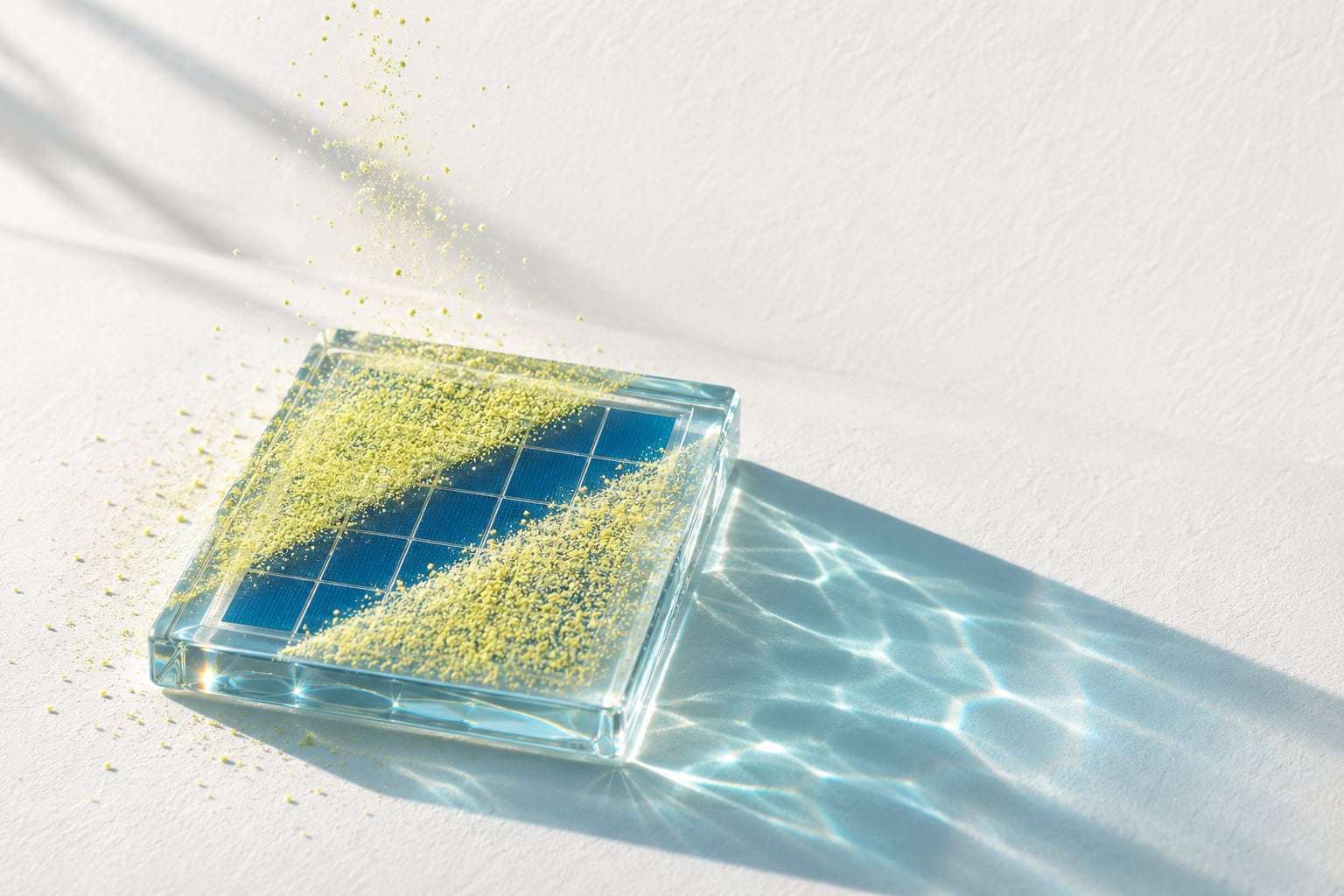
Does pollen really cut solar output?
A little, and it adds up through a dry spring. A thin, even film dims every panel at once, so the drop is gradual and easy to miss until you compare clear days.
When does it land?
April to June
- Jan
- Feb
- Mar
- Apr
- May
- Jun
- Jul
- Aug
- Sep
- Oct
- Nov
- Dec
How do I spot it?
Yellow on the car
If the windshield and patio table turn yellow-green each morning, the roof glass does too.
Haze at low sun
From the street at 8 a.m., a dull sheen instead of a dark, clean reflection of sky.
Tide lines after showers
A short shower pushes pollen into wavy lines and leaves a band along the bottom edge.
Flat clear-day peaks
Sunny-day production in late May sitting near April’s, even as the days get longer.
What does it do to output?
Pollen blocks a share of the light on every panel, so the loss is spread out rather than sharp. On its own it is usually modest, but it builds on any dust already there, and a light shower tends to set it in place instead of rinsing it. A heavy rain on tilted glass often clears most of it.
What can I do myself?
Do
- Look from the street with binoculars on a bright morning, when a film shows best.
- Compare clear-day totals in your app week to week through May.
- Wait for the cottonwood to finish in June, so you only wash once.
- On a ground mount, rinse with a garden hose early in the morning while the glass is cool.
Don’t
- Don’t climb onto the roof to sweep it; pollen is not worth a fall.
- Don’t dry-brush or wipe it; dry rubbing drags grit across the glass.
- Don’t add soap; the residue holds the next layer of pollen.
- Don’t rinse hot glass in the afternoon sun.
What does our crew do?
Time it after fluff
We book late June, after pollen and cottonwood, so one wash covers the whole spring.
Pure-water rinse
Soft brushes and deionized water at air temperature, top row down, before the glass warms.
Edge band cleared
Extra passes along the bottom frame, where showers left pollen in a line.
Proof in numbers
Before and after photos, and the next clear days compared with your baseline.
What do owners ask about pollen?
Will rain wash pollen off solar panels?
A soaking rain on tilted panels often rinses most of it away. A short shower or drizzle usually does not; it moves pollen into lines and leaves a band along the bottom edge as it dries. If your app still shows flat clear-day peaks after a storm, the film stayed.
When is the best time to clean pollen off panels?
Late June, for most Front Range roofs. Pollen runs from April into June and cottonwood fluff follows, so a wash in May often needs repeating. Waiting until both are done means one wash clears the whole spring. Our two-season plan books that slot for you.
Can pollen damage solar panels?
No, pollen does not harm the glass or the cells. It only dims the light reaching them. The risk comes from cleaning it badly: dry wiping, scrubbing with grit, or rinsing hot glass with cold water. Plain water and soft tools are all it needs.
How much output does pollen cost?
It depends on how thick the film gets and how long it stays, so we will not quote a number for your roof. An NREL-led study (Micheli and colleagues, 2019) mapped soiling losses of up to 7% at U.S. sites. Your own app shows your share: compare clear days before and after a wash.
Is a pollen wash worth it on a small array?
Sometimes not. On a small, steep roof, spring storms may clean the glass well enough on their own. Send us an app screenshot of a few clear days and we will tell you whether a wash, from $149 for up to 20 panels, is worth booking this year.
Seeing this on your glass?
Send a photo from the ground or a screenshot of your app, and we will say whether it needs us.